Tren “Maya”: Made in Germany (Vol. 1)

Anti-Copyright: Spread this report as much and as often as you like—print it, share it, copy it!
According to official discourse, infrastructure projects mean progress and development. At first glance, the railway and highway project "Mayan Train" (Tren Maya) appears to be a harmless initiative by the Mexican government: spanning over 1,500 kilometers, the new route is set to connect five states. Politicians and corporations promise jobs, a boost in tourism, and even a path to modernity. In reality, this megaproject means the destruction of the last rainforests in southern Mexico, the violation of Indigenous rights, land grabs and forced displacement, as well as increased militarization in one of the country’s most conflict-ridden regions.
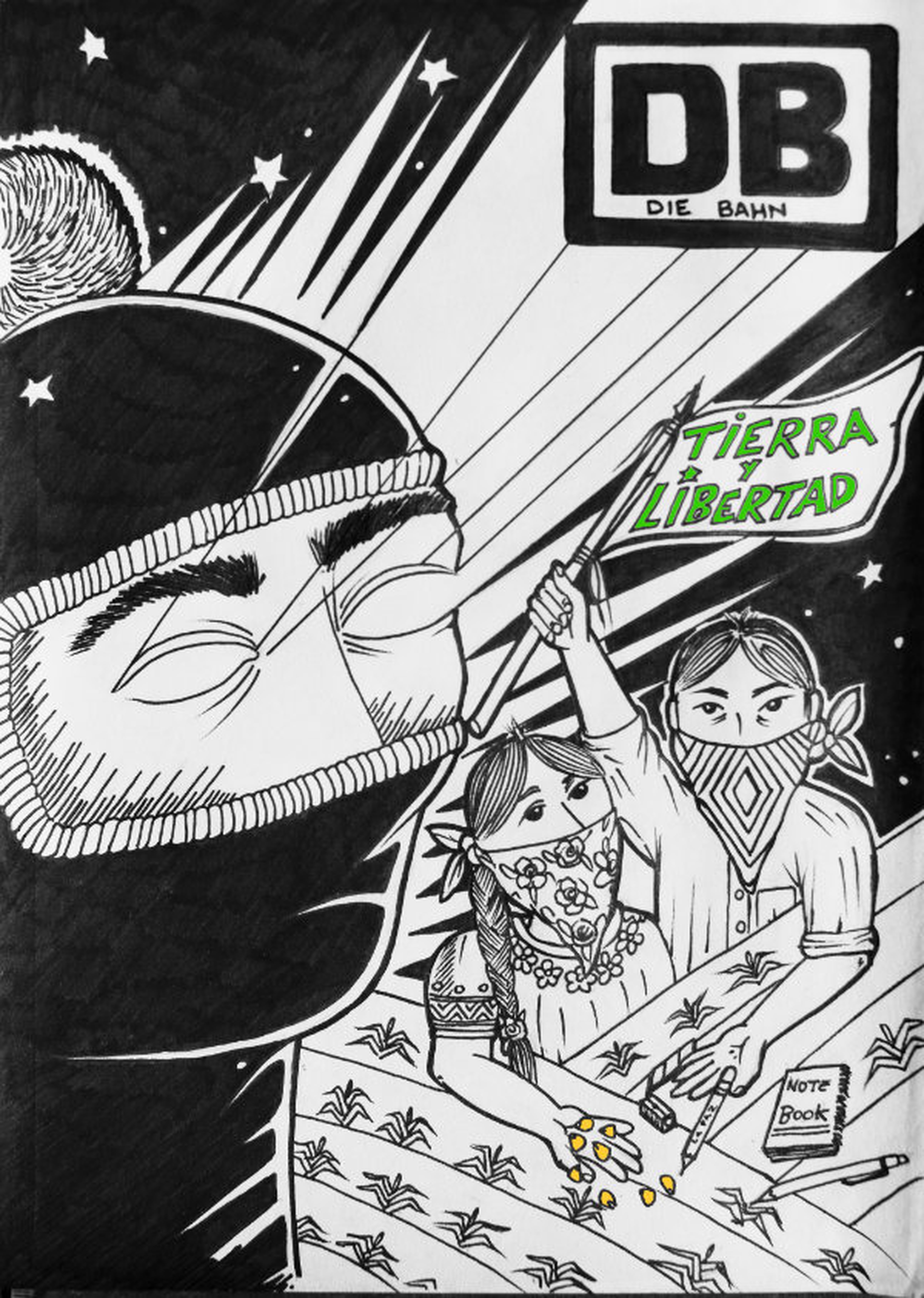
Meanwhile, a few stand to profit handsomely, driving the realization of the "Mayan Train" forward without restraint. German capital and German companies are involved in the planning, construction, and operation of the project. This report takes the Zapatistas’ journey through Europe as an opportunity to first describe the consequences of the project, then highlight the involvement of DB Engineering & Consulting, the interest of Siemens and TÜV Rheinland, and the connections to German arms manufacturers. The report concludes with an overview of resistance against the project and an interview with Dr. Sergio P. Díaz, a researcher at the University of Campeche who has been studying the project on-site for years and analyzing its geopolitical dimensions. He emphasizes: "The biggest mistake is to consider the 'Mayan Train' only as a train."
General Overview
The so-called "Mayan Train" (Tren Maya) is an infrastructure project in southeastern Mexico, spanning 1,500 kilometers from Palenque to Cancún, connecting the states of Chiapas, Tabasco, Campeche, Yucatán, and Quintana Roo. Supposedly, it will boost the (local) economy and tourism, with an estimated cost of 150 billion pesos (over 6 billion euros). The project is accompanied by the expansion of highway infrastructure. The mere fact that this and other megaprojects are led by the Mexican military raises concerns about the true motives behind the "Mayan" Train. The catastrophic impacts on people and nature have long been downplayed.
Environmental Destruction
The scale of environmental destruction in the vast area is difficult to fully grasp. "Studies conclude that the "Mayan" Train will lead to the degradation, fragmentation, and deforestation of 23 protected areas, including [UNESCO] World Heritage Sites," reports Greenpeace Mexico. For the first construction phase alone, 11 million trees are slated for felling. Underwater cave systems of cultural significance to Indigenous communities are at risk—ecosystems dependent on these water flows will also suffer. Additionally, the country’s largest groundwater reserves are threatened. An environmental impact assessment was conducted with deficiencies and without the inclusion of Indigenous peoples.
Violation of Indigenous Rights and Threats to Activists
"The consultation process with Indigenous communities regarding the "Mayan" Train did not meet all international human rights standards," states the UN Office of the High Commissioner for Human Rights. "Consultations are often conducted in contexts of threats, criminalization, and harassment, undermining their free and informed nature," emphasizes the UN Committee on the Elimination of Racial Discrimination.
At the same time, activists who oppose the project face grave danger. Those who speak out against the "Mayan" Train have received death threats, reports the NGO Front Line Defenders. In the past year alone, 23 human rights and land defenders were killed in Mexico. Thus, Mexico is one of the most dangerous countries for activists.
Militarization and Migration
The Mexican military is set to manage a large portion of the "Mayan" Train and will also profit from the project. This transfer of authority to the armed forces further militarizes one of the country’s most conflict-ridden regions: In the southern state of Chiapas, the Mexican military has waged a "low-intensity war" against the autonomous Zapatista communities for years. The increasingly aggressive actions of the Mexican government against refugees from Central America—carried out by the military—are also closely tied to the project. "If you map out the various megaprojects and infrastructure plans, you see that they are building blocks for a 'migrant blockade,' serving U.S. geopolitical interests," says Dr. Sergio Prieto Díaz, a lecturer at Colegio ECOSUR.
Urbanization and Opening for (global) Capital
The project serves as a gateway for the military, the state, and capital, threatening to permanently destroy the subsistence-based way of life and communal property systems of the affected population.
DB Engineering & Consulting – The Shadow Operator
As a so-called "shadow operator," the subsidiary of Deutsche Bahn (DB) is active in countries like Qatar, the United Arab Emirates, China, Brazil, and Colombia. In Mexico, DB secured a contract as part of a consortium with two other state-owned Spanish companies to advise and support the project.
"FONATUR [Mexico’s tourism development agency] has commissioned DB Engineering & Consulting GmbH to advise on railway operational decisions within the "Mayan" Train project. [...] The contract was signed on December 1, 2020, and runs until December 2023. It includes a contract sum of **8.6 million euros**," confirmed parliamentary state secretary Ferlemann.
The lack of public discussion about DB’s involvement in Germany may be linked to the company’s green image and environmentally friendly public relations. Since 2019, the red stripe on DB’s iconic ICE trains has been complemented by a green one, yet this "climate-friendliness" is a facade and a form of colonial outsourcing: A quarter of Germany’s total rail electricity comes from the coal-fired power plant Datteln IV, which burns coal imported from Colombia—where people are displaced and murdered to extract and export the so-called "blood coal." When DB claims to use "official" green energy, it is merely purchasing certificates—a small part of the company’s extensive greenwashing efforts.
Siemens Mobility – A Privilege to Be Part of the "Mayan" Train
As early as 2018, Siemens expressed interest in participating in the "Mayan" Train project, covering everything from energy generation and transmission, electrification, signaling technology, automation, to the trains themselves. This interest persisted in 2021—despite initial contracts being awarded to the French company Alstom. In March 2021, reports emerged of changes to the bidding process (initiated by Mexico’s tourism agency FONATUR). Several international corporations, apparently seeking contracts for additional sections, requested an extension of the submission deadline—originally set at three months—as it was deemed impossible to meet. Siemens was among those companies.
TÜV Rheinland – Certificates of Misery
Like Siemens, the German company TÜV Rheinland expressed interest in the "Mayan" Train project as early as 2018, even before concrete plans or studies on environmental impacts were available. The tasks assigned to TÜV Rheinland in the project are as extensive as those of DB or Siemens: Sandra Alamo, Director of Business Development at TÜV Rheinland Rail Mexico, stated in 2018 that the company could participate "from the pre-design phase, feasibility studies, material development, and everything necessary, up to the inspection and execution of the work."
TÜV has taken on similar roles in Mexico before, such as for Metro Line 12 in Mexico City, which collapsed in May 2021, killing over 20 people. TÜV’s questionable practices extend beyond Mexico: in Brazil, the company certified a dam as safe just before its collapse, resulting in the deaths of over 250 people.
The German Arms Industry and the "Mayan" Train
When examining the involvement of German companies in the Mayan Train project, it is important not to overlook actors who may seem unrelated at first glance. The Mexican military, which will manage the entire infrastructure project and profit from it, is a frequent customer of European—and particularly German—arms manufacturers. Despite companies like Heckler & Koch being embroiled in illegal arms deals with Mexico, the German government has continued to approve arms exports to the country. Much of this weaponry ends up in highly militarized regions, such as Chiapas, where the military maintains numerous bases around the autonomous Zapatista territories.
ILO Convention 169
ILO Convention 169 is the only international legal framework for the protection of Indigenous rights. Its core principles include consultation and participation procedures to ensure Indigenous peoples have a say in projects that affect them. Germany ratified the convention on April 15, 2021, after decades of delay. Since Deutsche Bahn is a state-owned company, we demand the strict implementation of ILO Convention 169 and, consequently, the withdrawal of DB and its subsidiaries from the "Mayan Train" project!